

There are a few times when just four letters can cause you to be confused when reading a whole conversation. For example, if someone responds to your message with “IDTS”, you will then wonder if that person is telling you no, is unsure about what they should say, is being funny, or is just trying to give you a very fast answer. Thankfully, the IDTS meaning in text is usually quite clear. Most of the time, IDTS means “I don’t think so” in everyday conversations.
People typically use this short form of abbreviation when they have doubts about something, do not agree with another person’s view, or would like to convey “no” to someone.
However, the way you say it is still important. A message such as “IDTS 😂” is perceived as less serious than a simple “IDTS.” Therefore, punctuation, emoticons, messages sent prior to the current message, and the nature of your connection with the person sending the message can all impact how the response is interpreted.
In addition, the acronym “idts” is commonly found in text messages, social media posts, game chats, direct messages (DMs), and group chats when individuals wish to provide a quick response. This article will help you understand the meaning behind this acronym, how people use it in practice, its various tones, and how to interpret it without overthinking. So, keep reading.
What Does IDTS Mean in Text?
In typical everyday conversations, IDTS stands for “I Don’t Think So.” IDTS can be used as a casual way to respond to ideas, statements, or questions that you are unsure about, disagree with, or believe have a negative answer.
For example:
“Do you think Jordan is coming tonight?”
“IDTS.”
That normally means:
“I don’t think so.”
It can also communicate ideas such as:
- Probably not
- I doubt it
- I’m not convinced
- I don’t agree
- That doesn’t seem right
- I’m leaning toward no
Now compare:
“IDTS 😂”
This sounds casual and playful.
On the other hand:
“IDTS. That story doesn’t add up.”
The second version feels more serious because the sender is challenging what was said.
Therefore, the basic definition remains the same, while the emotional tone changes with context.
IDTS Different Meanings
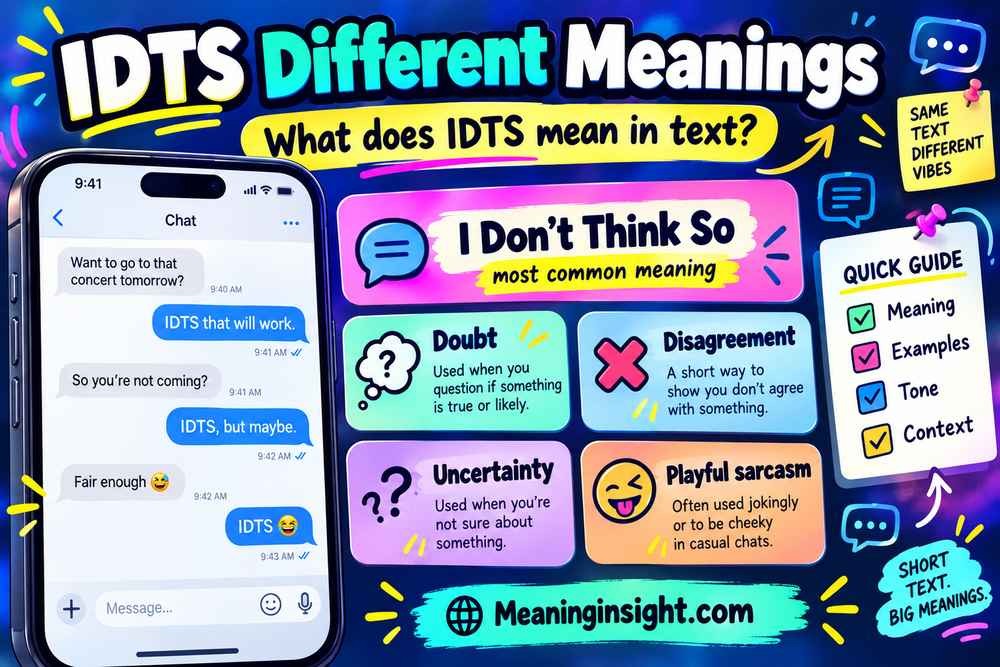
IDTS Meaning in Text typically refers to “I Don’t Think So.” However, those four letters can sometimes have other meanings in professional settings, technical systems, companies, projects or private groups. Since these alternate meanings are so infrequent, the context of the situation will most likely be your best indicator as to what is being referred to.
The most common use of texting doesn’t usually require specialized definitions. If somebody replies “IDTS” after you ask a question, “I Don’t Think So” is almost certainly what they mean.
| IDTS Meaning | How It Is Usually Used | Original Example |
| I Don’t Think So | Casual disagreement, doubt, or a soft negative answer | “IDTS, she said she already had plans.” |
| I Didn’t Think So | Rare conversational shorthand referring to something previously doubted | “IDTS at first, but the explanation changed my mind.” |
| Integrated Data Tracking System | Possible name for an internal data or reporting platform | “The records were uploaded into the IDTS this morning.” |
| Information/Data Tracking System | Internal abbreviation for software used to monitor information | “Check the IDTS before submitting the report.” |
| Instructional Design and Training Services | May appear as the name of an educational or training department | “IDTS helped us rebuild the online course.” |
| Internal Department or Team Name | Organizations may assign the initials to a department | “Send the request to IDTS for review.” |
| Research Project Initials | A project or study title may be shortened to IDTS | “The IDTS project enters its second phase next month.” |
| Gaming Group or Clan Tag | Teams and online communities may use IDTS as identifying initials | “IDTS reached the tournament final.” |
| Username or Brand Initials | May form part of a creator name, company, or social handle | “I found the IDTS account you mentioned.” |
| Private Inside Meaning | Friends may create their own meaning for the abbreviation | “IDTS means something completely different in our group chat 😂.” |
Important Difference Between IDTS and IDT
IDTS and IDT look almost identical, so they are easy to confuse. However, they are usually used a little differently.
IDTS means:
“I Don’t Think So.”
Meanwhile, IDT often means:
“I Don’t Think.”
Because “I don’t think” normally introduces another thought, IDT is more likely to appear before additional words.
For example:
“IDT she knows yet.”
means:
“I don’t think she knows yet.”
By comparison:
“Is she coming?”
“IDTS.”
works as a complete response.
Although casual texting is not governed by strict grammar rules, this small distinction can make conversations easier to interpret.
IDTS Meaning in Texting, Chat & Full Form
The full form of IDTS is “I Don’t Think So.” When used in Text during online chats, “IDTS” acts as an abbreviated response to provide a negative answer, express uncertainty, or disagree without typing an entire sentence.
Consider this exchange:
Ava: “Do you think the restaurant is still open?”
Mia: “IDTS, it usually closes early.”
Mia is leaning toward no, although she may not be completely certain.
Now compare:
Noah: “That was definitely the best movie in the series.”
Ethan: “IDTS 😂.”
Here, Ethan is not answering a factual question. Instead, he is casually disagreeing with Noah’s opinion.
In addition, IDTS will allow the response to appear less definitive than the standard “no.” Nonetheless, in some situations where there is gravity, responding with just four letters will continue to seem unconcerned.
IDTS Slang Meaning & Why Context Matters
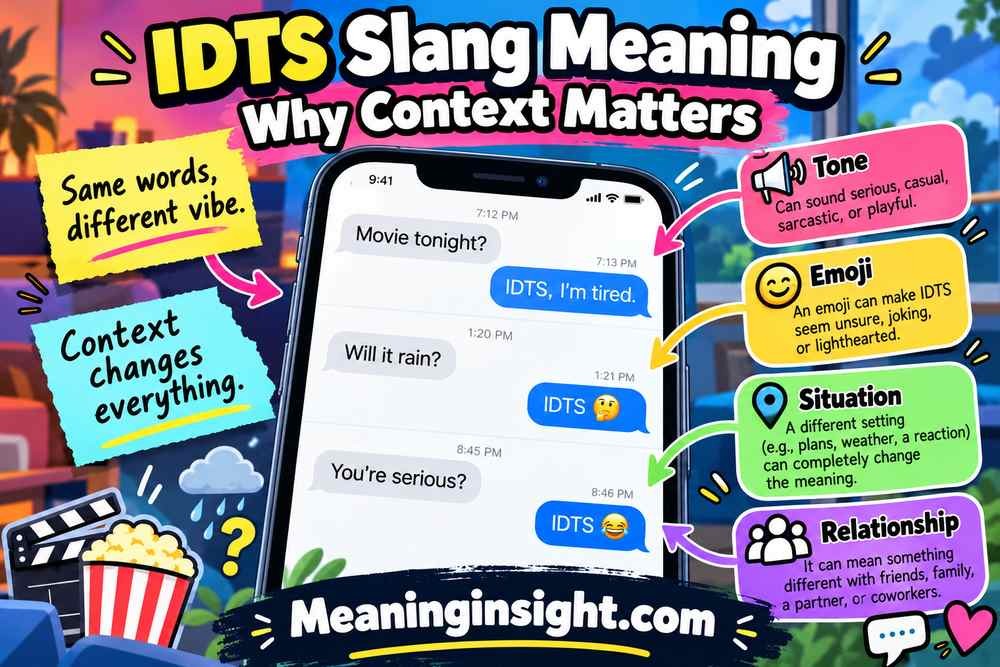
The basic IDTS meaning in Text is simple, but context decides whether the message sounds uncertain, playful, skeptical, or blunt.
Compare:
“IDTS.”
This may sound neutral, though it can also feel slightly cold.
Now consider:
“IDTS lol.”
Adding “lol” makes the disagreement much lighter.
Similarly:
“IDTS 😭.”
may express disbelief, amusement, or frustration depending on the topic.
Meanwhile:
“IDTS, honestly.”
sounds firmer and more serious.
The relationship also matters. A close friend saying “IDTS bro 😂” probably feels harmless. On the other hand, replying only “IDTS” to an important workplace concern could appear dismissive.
Therefore, read the surrounding conversation instead of interpreting the abbreviation in isolation.
How Popular Uses of IDTS in Everyday Conversations
IDTS appears in several common situations. Although the definition stays fairly stable, the reason someone uses it can vary.
IDTS When You Are Unsure
Someone might ask:
“Is that store open after 10?”
You could reply:
“IDTS, but check before you go.”
Here, the sender is uncertain rather than strongly disagreeing.
IDTS When You Disagree
For example:
“That was his best album.”
“IDTS, the older one was better.”
The response expresses an opinion without turning the conversation into an argument.
IDTS as a Soft No
Someone may ask:
“Can we finish this tonight?”
A reply could be:
“IDTS, there’s still too much left.”
Instead of saying a hard “no,” the sender gives a softer negative answer.
IDTS During Playful Arguments
Friends may joke:
“I’m obviously the funniest person here.”
“IDTS 😂.”
Because the exchange is playful, the abbreviation sounds teasing rather than rude.
IDTS When Correcting an Assumption
For instance:
“So tomorrow’s class is canceled?”
“IDTS. I think they only changed the room.”
As a result, the abbreviation acts as a quick correction.
How to Use IDTS in a Text Effectively
IDTS works best in informal conversations where both people are comfortable with texting shorthand.
To Express Doubt
“IDTS he’s coming tonight.”
The sender believes he probably will not come.
To Disagree Casually
“IDTS, season two was way better.”
This sounds conversational rather than confrontational.
To Give a Soft Negative Answer
“Can we make it there by six?”
“IDTS, traffic is terrible.”
The response means something close to “probably not.”
To Keep a Joke Going
“I’m clearly the responsible one.”
“IDTS 😂.”
The laughing emoji makes the disagreement playful.
To Correct Someone Gently
“So she quit her job?”
“IDTS. I heard she’s just taking time off.”
However, if the subject is sensitive or important, a complete sentence usually sounds more thoughtful.
IDTS Texting Examples
Seeing the abbreviation inside realistic conversations makes the tone easier to recognize.
Example 1: Uncertain
Lena: “Do you think they’ll reopen today?”
Sophie: “IDTS, it still looks closed.”
Sophie is leaning toward no but is not completely sure.
Example 2: Friendly Disagreement
Ryan: “That team is definitely winning the final.”
Jake: “IDTS 😂.”
Jake disagrees, although his response is clearly playful.
Example 3: Soft Rejection
Maya: “Can you hang out tonight?”
Nina: “IDTS, I’ve got a lot of work left.”
The answer is negative without sounding harsh.
Example 4: Checking a Fact
Chris: “You already sent the form, right?”
Sam: “IDTS. Let me check.”
Sam is unsure and wants to verify.
Example 5: Stronger Opinion
Ava: “That’s definitely what she meant.”
Noah: “IDTS. Her last message sounded different.”
In this example, IDTS Meaning in Text is closer to “I disagree” or “I’m not convinced.”
IDTS Meaning on Social Media
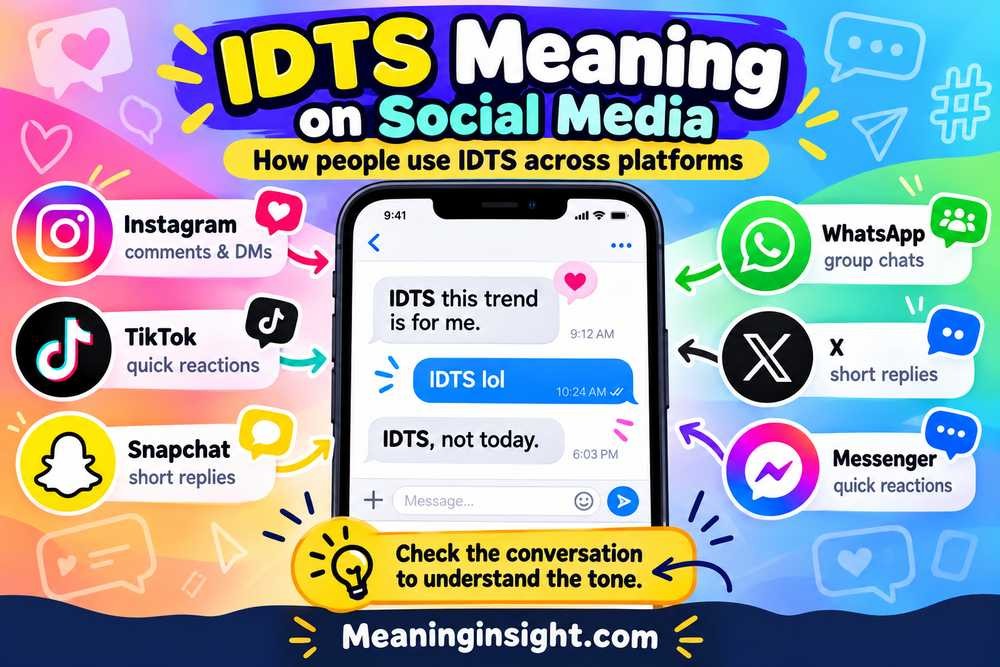
On social media, IDTS still normally means “I Don’t Think So.” Users drop it into comments, DMs, Story replies, and quick reactions when they want to disagree or question a claim without writing much.
For example:
“Best song of the year.”
Someone may reply:
“IDTS 😭.”
The disagreement is obvious, although the emoji keeps it casual.
Another user might write:
“IDTS this trend is disappearing anytime soon.”
Here, IDTS means something closer to “I doubt it.”
Because social media conversations are often short, tone can be harder to judge. Therefore, emojis and surrounding replies are especially useful.
IDTS Meaning in Text Snapchat
On Snapchat, IDTS Meaning in Text usually stays the same: “I Don’t Think So.”
For example:
“Do you think he saw my Story?”
“IDTS.”
The sender probably believes he did not.
Another message might say:
“IDTS 😂 you’re overthinking everything.”
In this case, the laughing emoji makes the response feel friendly and reassuring.
Snapchat conversations are usually quick, so that IDTS may appear without much explanation.
IDTS Meaning in Text Instagram
On Instagram, people may use IDTS in comments, DMs, or Story replies.
For instance:
“This is their best post ever.”
“IDTS, last week’s was better.”
That is straightforward disagreement.
Someone may also write:
“IDTS she meant it that way.”
Here, the person doubts someone else’s interpretation.
In addition, comment sections often encourage short responses, so IDTS fits naturally into quick debates.
IDTS Meaning in Text TikTok
TikTok users frequently rely on short slang, which makes IDTS easy to spot in comments.
For example:
“This trend is already dead.”
“IDTS, it’s still everywhere.”
The second user disagrees.
Another reply could be:
“IDTS bro 😭.”
That could be humorous, skeptical, or dramatic depending on the video, rather than being hostile.
Reading comments around a conversation on TikTok will allow you to better understand the emotional tone of the discussion.
IDTS Meaning in Text WhatsApp
On WhatsApp, IDTS Meaning in Text is often easier to understand because users usually have more conversation history.
For example:
“Do you think tomorrow’s meeting is canceled?”
“IDTS. Nobody has said anything.”
The sender doubts that it has been canceled.
In a group chat, someone might write:
“We can finish everything tonight.”
“IDTS 😂.”
That sounds skeptical but friendly.
Therefore, the same abbreviation is capable of handling uncertainty, opinion, and casual disagreement.
Does IDTS Meaning in Text Differ for a Girl or a Guy?
No. IDTS Meaning in Text does not change according to gender. It doesn’t matter if a female or male uses the term IDTS; the common usage remains “I Don’t Think So.”
However, Tone can vary based on the connection you have with the other person and how the previous interaction occurred.
For example:
“IDTS 😂.”
From a close friend, it probably sounds playful.
Meanwhile:
“IDTS. I think you misunderstood me.”
sounds more serious regardless of who sends it.
The better approach is to focus on wording, emojis, and conversation history instead of assuming that gender changes the definition.
IDTS Meaning in Text From a Guy
If a guy sends:
“IDTS.”
He is usually expressing doubt or disagreement.
For example:
“Do you think she’s coming?”
“IDTS.”
That means he probably thinks she is not.
However:
“IDTS bro 😂.”
Sounds much more casual.
Therefore, do not search for a hidden romantic or emotional meaning simply because the sender is male. The conversation itself tells you more.
IDTS Meaning in Text From a Girl
A girl can use the abbreviation in the same ways.
For example:
“IDTS 😭.”
may sound playful or dramatic.
On the other hand:
“IDTS. I’m pretty sure they changed the plan.”
sounds factual and serious.
Again, gender does not define the meaning. Context does.
Is IDTS Rude, Flirty, or Friendly?
IDTS is generally neutral, although the rest of the message can make it sound friendly, flirty, blunt, or dismissive.
Can IDTS Be Flirty?
Yes, although the abbreviation itself is not romantic.
For example:
“You really think you can ignore me all day?”
“IDTS 😉.”
The wink creates the flirtiness.
Another example might be:
“Think you can resist me?”
“IDTS 😂.”
Again, the surrounding conversation matters far more than the abbreviation itself.
Can IDTS Be Friendly?
Absolutely.
Friends may write:
“You’re definitely winning this argument.”
“IDTS 😂.”
That sounds playful rather than confrontational.
Similarly, someone might say:
“IDTS bro, but we’ll see.”
Which feels casual and conversational.
Can IDTS Be Rude?
Sometimes.
Imagine someone writes a thoughtful paragraph explaining their concern and receives only:
“IDTS.”
That reply may feel dismissive.
However, brief wording is not automatically rude. Some people naturally send short messages.
Can IDTS Sound Dismissive?
Yes.
Repeatedly saying “IDTS” without explaining why can make it seem as though you are shutting down the conversation.
Instead, during an important discussion, write something like:
“IDTS, because the dates don’t match.”
Adding a reason makes the disagreement clearer and more respectful.
Read More: FYM Meaning in Text: Definition, Uses & Real Examples
How to Reply When Someone Says IDTS
So, your best reply depends on why the person used it.
For a simple disagreement:
“Fair enough.”
If you want an explanation:
“Why not?”
When they sound uncertain:
“Yeah, I’m not sure either.”
For a playful reply:
“😂 We’ll see.”
If you want more detail:
“What makes you think that?”
During a serious disagreement:
“I understand your point, but here’s why I see it differently.”
And if you genuinely do not know the abbreviation:
“IDTS as in ‘I don’t think so’?”
Instead of overthinking four letters, respond to the purpose of the message.
Is IDTS Appropriate in Every Conversation?
No. IDTS belongs mainly in informal communication.
It works naturally in:
- texts with friends
- family chats
- gaming conversations
- Snapchat messages
- Instagram DMs
- TikTok comments
- WhatsApp groups
- casual class chats
- relaxed coworker conversations
However, it is usually better to avoid IDTS in:
- formal emails
- academic writing
- job applications
- official reports
- client communication
- professional feedback
- sensitive disagreements
Instead of writing:
“IDTS this proposal will work.”
a professional message would sound better as:
“I’m not confident that this proposal will work in its current form.”
The second version is clearer and more appropriate.
Best Conversational Replies to IDTS in Different Situations
There is no single perfect response to IDTS. Instead, match your reply to the conversation. However, take a look at better conversational replies.
| Situation | Message You Receive | Natural Reply |
| Friendly disagreement | “IDTS 😂.” | “Haha, we’ll see.” |
| Uncertainty | “IDTS, maybe not.” | “Yeah, I’m not sure either.” |
| Soft rejection | “IDTS, I can make it.” | “No worries, maybe next time.” |
| Opinion debate | “IDTS, the first one was better.” | “Fair point.” |
| You want a reason | “IDTS.” | “Why not?” |
| Playful conversation | “IDTS bro 😭.” | “You know I’m right 😂.” |
| Serious disagreement | “IDTS. That’s not what happened.” | “Okay, tell me how you see it.” |
| Casual work chat | “IDTS this file is final.” | “Got it. What still needs changing?” |
| Unsure of meaning | “IDTS.” | “You mean ‘I don’t think so’?” |
IDTS vs Similar Texting Slang
Several abbreviations express uncertainty, disagreement, or personal opinions. However, each one carries a slightly different meaning. For example:
“IDK if she’s coming.”
means that you do not know.
On the other hand:
“IDTS.”
suggests that you believe she probably is not coming.
That difference may seem small, but it changes the confidence and direction of the reply.
| Slang | Meaning | Main Difference |
| IDTS | I Don’t Think So | Shows doubt, disagreement, or a soft no |
| IDK | I Don’t Know | Shows lack of knowledge |
| IDC | I Don’t Care | Expresses indifference |
| IDT | I Don’t Think | Usually introduces a longer thought |
| IMO | In My Opinion | Introduces a personal view |
| TBH | To Be Honest | Signals honesty or directness |
| NGL | Not Gonna Lie | Introduces a candid opinion |
| NAH | No / Not really | Usually firmer and more casual |
| FR | For Real | Shows agreement, surprise, or emphasis |
| MAYBE | Maybe | Expresses uncertainty without strongly leaning no |
Common Mistakes To Avoid When Understanding IDTS

Most of the time, understanding IDTS Meaning in Text is straightforward. Nevertheless, confusion can happen when people ignore the conversation around it.
| Common Mistake | Better Interpretation |
| Assuming IDTS is always rude | It is often neutral or casual |
| Treating IDTS as a definite “no” | It can mean “probably not” |
| Confusing IDTS with IDK | IDK means uncertainty; IDTS leans toward doubt or disagreement |
| Ignoring emojis | Emojis can soften or intensify the message |
| Assuming gender changes its meaning | Context matters more than gender |
| Using IDTS in formal communication | Write a full sentence instead |
| Reading playful IDTS as serious | Consider the relationship and surrounding messages |
| Assuming every IDTS requires a reply | Sometimes it simply answers the question |
| Confusing IDTS with IDT | IDT often introduces another phrase |
| Ignoring specialized contexts | Organizations may occasionally use IDTS differently |
Conclusion
IDTS contains only four letters, but it can cover several common conversational situations. Most often, it means “I Don’t Think So,” making it a quick way to show doubt, disagree with someone, or answer a question with a softer version of “no.”
The easiest way to understand IDTS Meaning in Text is to examine the full conversation. First, look at what was said before the abbreviation; next, notice punctuation, emojis, and extra words. Then, consider whether the sender sounds uncertain, playful, skeptical, or serious.
Finally, respond according to the tone. “Fair enough,” “Why not?”, “We’ll see 😂,” and “What makes you think that?” can all be natural responses depending on the situation.
You do not need to overanalyze IDTS. In most everyday chats, it is simply a fast and convenient way to say, “I don’t think so.”
FAQs
What Does IDTS Mean in Texting?
IDTS usually means “I Don’t Think So.” People use it when they disagree, doubt something, or believe that the answer to a question is probably no.
What Is the Full Form of IDTS?
The full form of IDTS is “I Don’t Think So.” It is commonly used in texts, DMs, social media comments, and group chats.
What Does IDTS Stand For?
IDTS most commonly stands for “I Don’t Think So.” For example, if someone asks, “Do you think they’ll arrive today?” and you reply “IDTS,” you are saying that you probably do not expect them to arrive.
Is IDTS Rude?
Not automatically. IDTS can sound casual, playful, uncertain, or slightly dismissive depending on the wording and context. A bare “IDTS.” may feel blunt, while “IDTS 😂” sounds much lighter.
What Should I Reply to IDTS?
Natural replies include “Fair enough,” “Why not?”, “We’ll see,” “What makes you think that?”, or “Yeah, I’m not sure either.” Choose a response that matches the tone of the conversation.
Is IDTS the Same as IDK?
No. IDK means “I Don’t Know,” while IDTS means “I Don’t Think So.” IDK expresses uncertainty, whereas IDTS usually suggests that the speaker is leaning toward disagreement or a negative answer.
What Does IDTS Mean on Snapchat or TikTok?
On Snapchat and TikTok, IDTS still normally means “I Don’t Think So.” It often appears in quick reactions, jokes, opinion debates, comments, and casual disagreements.