
You share a funny video in your group chat and your buddy texts back: Is that you? Bro, you’re DTM. You then stare at that message, waiting to see if they will respond laughing at your joke or chastising you. Did you screw something up, or are they just messing with you? That’s the frustrating thing about internet slang.
Certain letters you can write should be understood completely differently depending on the conversation. Yeah, not everything goes through smoothly, right? Usually, DTM Meaning in Text refers to a phrase people use against someone who is acting too dramatic, trying too hard or overreacting. However, it can also be more confusing in certain circumstances.
In this guide, you will learn about its meaning, how people use it on social media, and real examples of conversations. Later, you will know the emotional meanings behind it, common misconceptions to watch out for and how to reply without making things awkward.
What Does DTM Mean in Text?
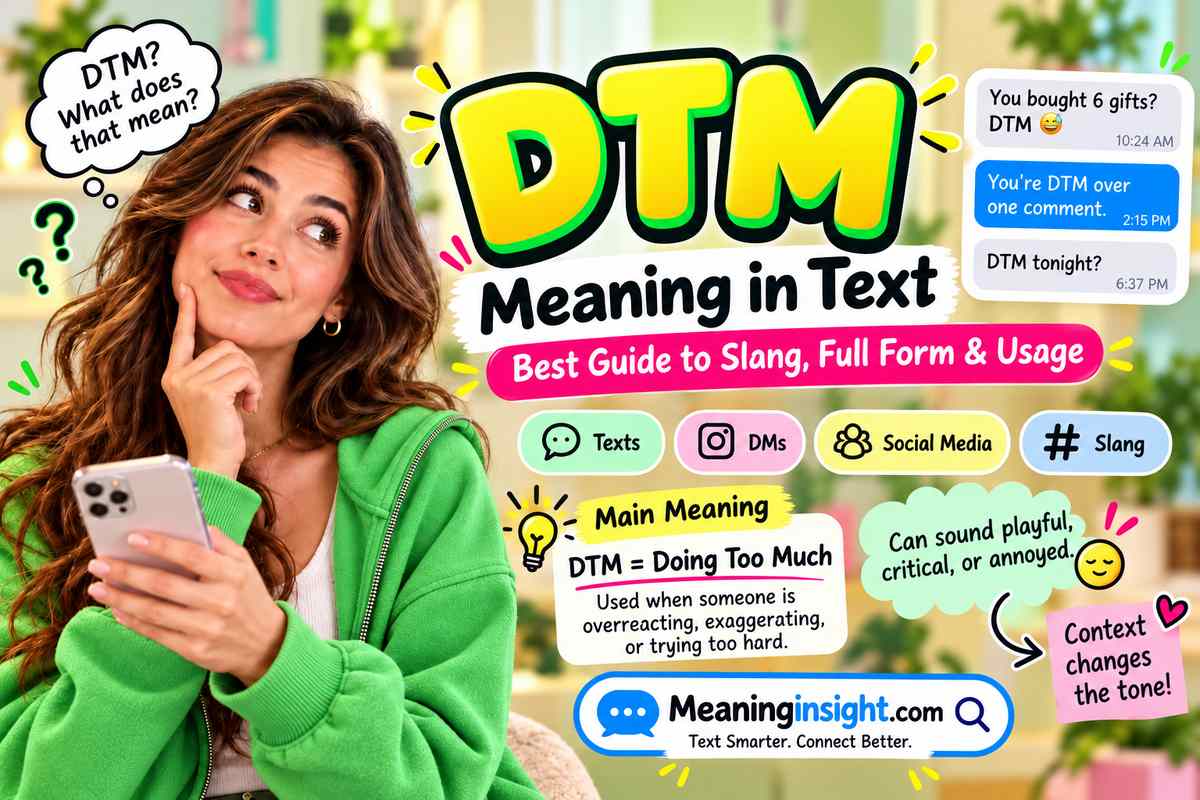
DTM most commonly stands for “Doing Too Much.” And so, people use it when someone acts like something is more of a big deal than they are making it.
For example:
Emma: “I bought six different outfits just for tomorrow’s coffee date.”
Noah: “Girl, you’re DTM!”
Noah is teasing Emma for putting excessive effort into a simple outing.
However, another conversation might look different.
Lily: “I’m tired of arguing with you.”
Jake: “DTM tonight. I need space.”
That said, here Jake may mean “don’t text me.” The acronym relies less heavily on standardization in this case.
And, this is where you will need to realize that the DTM Meaning in Text cannot be assumed through one direct message. Instead, it needs to be gathered from other words, associations and emotional tone.
Origin & Historical Overview of DTM Slang Meaning
The term DTM originated from the spoken phrase: “doing too much”. It is an indication of excessive, noisy, or complicated behavior. The phrase relates to African American English and informal speech. In general, calling someone doing too much is derogatory, playful ribbing, or an endearing observation.
When social networking & texting became popular, people started to shorten everyday phrases into an abbreviation. As a result, doing too much became DTM in casual online talk. Social media accounts began to showcase DTM as early as 2017. The abbreviation is documented as an internet slag of words, with entries dating back to 2018. However, there isn’t a reliably established single inventor or exact creation date.
As time passed, it became a well-known phrase to use on group chats, memes, comments or short-form videos. Today, users employ it to react quickly to behavior that seems excessive, whether genuinely annoying or amusingly impressive.
DTM Different Meanings
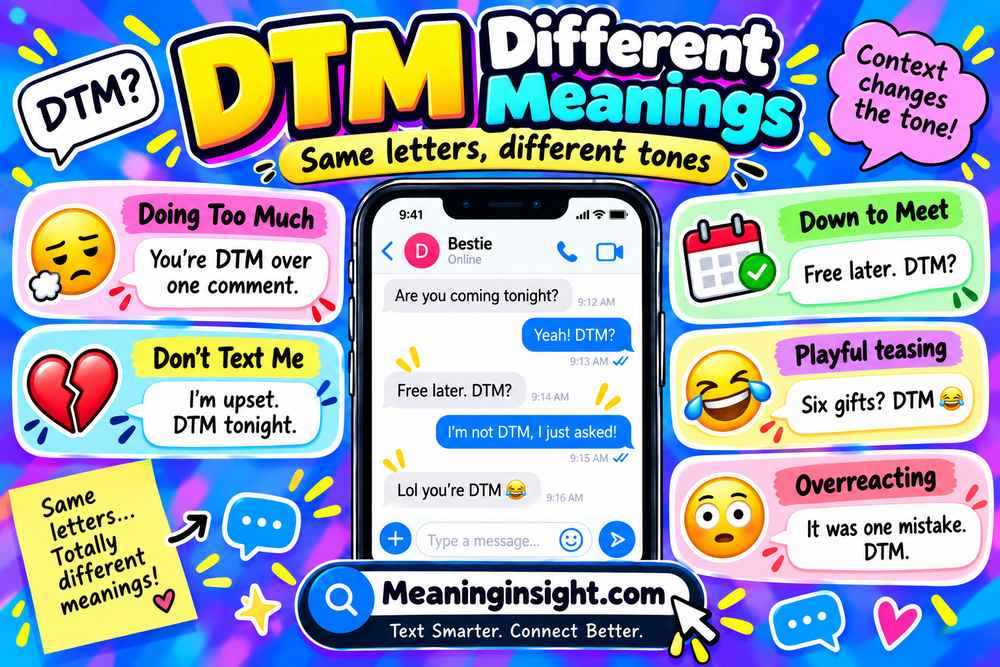
The main definition of DTM is doing too much. It also has many meanings in other conversations. Some are the result of established slang, while others lean heavily on the sender’s preference for shorthand. So, look at the table below to get a more enriched meaning of DTM.
| DTM Meaning | How It Is Usually Used | Original Example |
| Doing Too Much | Criticizing excessive behavior | “You’re DTM over one comment.” |
| Don’t Text Me | Asking someone to stop messaging | “I’m upset. DTM tonight.” |
| Down to Meet | Indicating availability to meet | “I’m free after lunch. DTM?” |
| Dead to Me | Expressing strong rejection | “After that betrayal, DTM.” |
| Playful teasing | Calling someone unnecessarily dramatic | “Three birthday cakes? DTM!” |
| Excessive effort | Describing someone going overboard | “You decorated the entire street? DTM.” |
| Overreaction | Criticizing an intense response | “It was one mistake. You’re DTM.” |
| Inside meaning | Personal shorthand between friends | “DTM is our private group joke.” |
Important Key Takeaways
These interpretations aren’t equally common. The denotation that most commonly refers to how the word is used in everyday texting and social media comments (doing too much) remains the most recognizable.
On the one hand, “Down to Meet” has contextual relevance within conversation modes related to social planning. Moreover, “Don’t Text Me” usually needs more definitional emotional context.
If the conversation doesn’t give you enough clues, then ask what the sender means because misunderstandings happen easily.
DTM Full Form & Its Meaning in Texting
The primary full form of DTM is “Doing Too Much.” Each character stands for a single word, thus making it simple to input in rapid conversations.
For instance:
Ryan: “I called the restaurant eight times because they didn’t answer.”
Mia: “You’re seriously DTM.”
Mia believes Ryan is putting unnecessary energy into the situation.
On the other hand:
Alex: “We’re both free tonight. DTM?”
Here, DTM could mean “Down to Meet,” depending on the sender’s vocabulary.
While there are other definitions, the purpose of the post usually makes it easy to discern meaning.
Common Uses of DTM In Everyday Conversations
So, respond accordingly to not just the abbreviation but what the sender means. To get more uses, you should take a look at the details below.
DTM for Meeting Someone
Suppose a friend messages:
“I’m free around seven. DTM?”
You could answer:
“Yeah, let’s meet at the café!”
In this situation, the sender likely means “Down to Meet,” not “Doing Too Much.”
DTM for a Ride
Imagine reminding your friend repeatedly to book a taxi.
Friend: “Relax, you’re DTM.”
You: “Okay, I’ll stop reminding you.”
The reply acknowledges that your reminders might feel excessive.
DTM for Deliveries
You message a delivery company several times about a package.
Your roommate jokes:
“You’ve checked the tracking page twenty times. DTM!”
A natural response would be:
“I know, I’m just excited!”
Here, the comment is playful rather than seriously critical.
DTM for Work or School
A classmate says:
“You’ve made forty slides for a five-minute presentation. You’re DTM.”
You might reply:
“Fair enough. I’ll shorten it.”
On the other hand, don’t incorporate trendy or unfamiliar slang in formal workplace communications since their tone can be misinterpreted.
Why Context Matters With DTM Slang
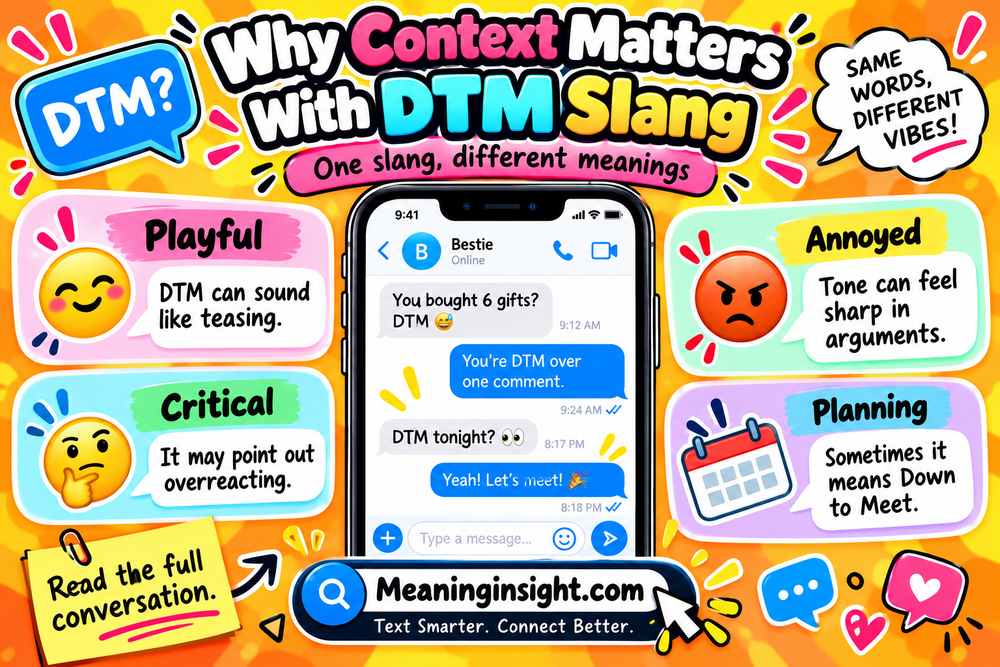
DTM can have a humorous, critical, annoyed or admirable inflection. For example, “You made homemade cupcakes for everyone? DTM!” might communicate affectionate surprise. Meanwhile, “Stop calling me. You’re DTM” suggests someone is becoming uncomfortable.
Interpretation can also be affected by punctuation and emojis. A teasing comment can come with a laugh emoji, and the same exact abbreviation would be deceptively combative if someone used an angry expression.
Moreover, how participants relate to each other matters. So, understanding the DTM Meaning in Text is reading between the lines based on what had transpired before the text and how that sender typically responds.
Effective Strategy to Use DTM in a Text
So to make this work, DTM is at its best in a casual conversation where the meaning is already established.
To Playfully Tease a Friend
“You had three costume changes for a single dinner? DTM!”
When friends calmly make fun of each other, this sounds funny.
To Point Out Overreacting
“It’s just a small delay. You’re DTM.”
The sender believes the reaction is disproportionate.
To Express Annoyance
“You’ve been arguing about this for hours. DTM.”
This communicates frustration, although a softer explanation might work better.
To Compliment Excessive Effort
“You decorated the entire garden for my birthday? DTM, but I love it!”
Here, the criticism becomes affectionate praise.
To Ask for Personal Space
“I’m not ready to talk. Don’t text me tonight.”
Although some users shorten this to DTM, spelling it out makes your boundary clearer.
DTM Texting Examples
The following examples show how the DTM Meaning in Text changes in everyday conversations.
Example 1: Casual Conversation
Sophie: “I ordered four desserts because I couldn’t choose.”
Daniel: “You’re DTM!”
Sophie: “Don’t judge me. They’re all delicious!”
Daniel is joking about Sophie’s enthusiasm.
Example 2: Supporting a Friend
Olivia: “I decorated the whole apartment for Mom’s birthday.”
Grace: “You’re DTM, but she’s going to love it.”
Olivia: “That’s what I’m hoping!”
The comment recognizes excessive effort positively.
Example 3: Snapchat Conversation
Ryan: “I sent fifteen snaps of my new sneakers.”
Ethan: “Bro, DTM!”
Ryan: “They’re my favorite pair!”
Ethan is teasing Ryan for sending too many updates.
Example 4: Making Plans
Zara: “There’s a concert nearby tonight. DTM?”
Aiden: “Sure! What time?”
Zara: “Doors open at eight.”
Here, DTM likely means “Down to Meet.”
Example 5: A Serious Disagreement
Chris: “I need some time alone.”
Jordan: “Can we talk now?”
Chris: “Please don’t text me tonight.”
This illustrates a clearer alternative to using DTM when establishing a personal boundary.
DTM Meaning In Text On Social Media
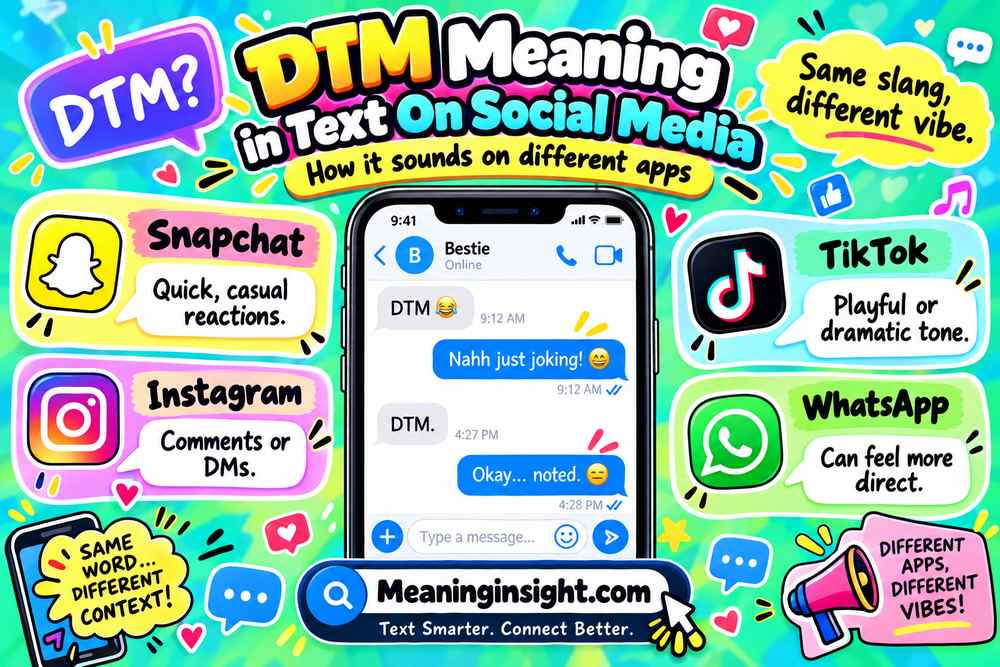
DTM appears in captions, comments, memes, and private messages across different platforms.
For instance, someone might comment, “You DTM!” under a video showing an unnecessarily elaborate cooking experiment.
However, whether that reaction is at all positive or negative will depend on how the video is framed.
DTM is a more casual form of language that was created by users themselves as opposed to built-in social media features. Because of this, usage can differ from one community to another.
DTM Meaning in Text On Snapchat
Snapchat users may automatically send DTM in reactions to repeated snaps, dramatic stories or over-messaging.
For example:
“You posted your breakfast from twelve angles. DTM!”
This is probably playful teasing.
Alternatively:
“You’ve sent me ten messages about the same thing. You’re DTM.”
The sender can be overwhelmed themselves. So take note of whether the dialogue is funny or tense.
DTM Meaning in Text On Instagram
Comments on Instagram and direct messages usually concern fashion, lifestyle, and personal updates. You know what I’m talking about; someone posts images of a lavishly decorated birthday party.
A friend comments:
“Those decorations are DTM!”
Depending on the relationship, this could be admiring or critical.
Meanwhile, “You’re DTM in these comments” may suggest that someone is arguing unnecessarily.
The abbreviation itself doesn’t tell you whether the reaction is positive.
DTM Meaning in Text On TikTok
TikTok users may use DTM when discussing dramatic performances, elaborate trends, or exaggerated reactions.
For example:
“He made a fifteen-minute explanation about one missing sock. DTM!”
The humor comes from the mismatch between a small problem and an excessive response.
Similarly, “This outfit is DTM in the best way” can express admiration.
Although DTM is common internet slang, it isn’t an official TikTok feature.
DTM Meaning in Text On WhatsApp
WhatsApp conversations often involve friends, relatives, classmates, and coworkers.
For instance:
“You’ve reminded everyone about tomorrow’s picnic five times. DTM!”
This may be friendly teasing.
On the other hand, someone saying Please leave me alone, DTM is more of a serious problem.
As WhatsApp Convos can have potential personal obligations involved, think about whether the abbreviation is suitable when written.
Read More: ASL Meaning in Text: Definition, Uses & Real Examples
Does DTM Meaning in Text Differ for a Girl or a Guy?
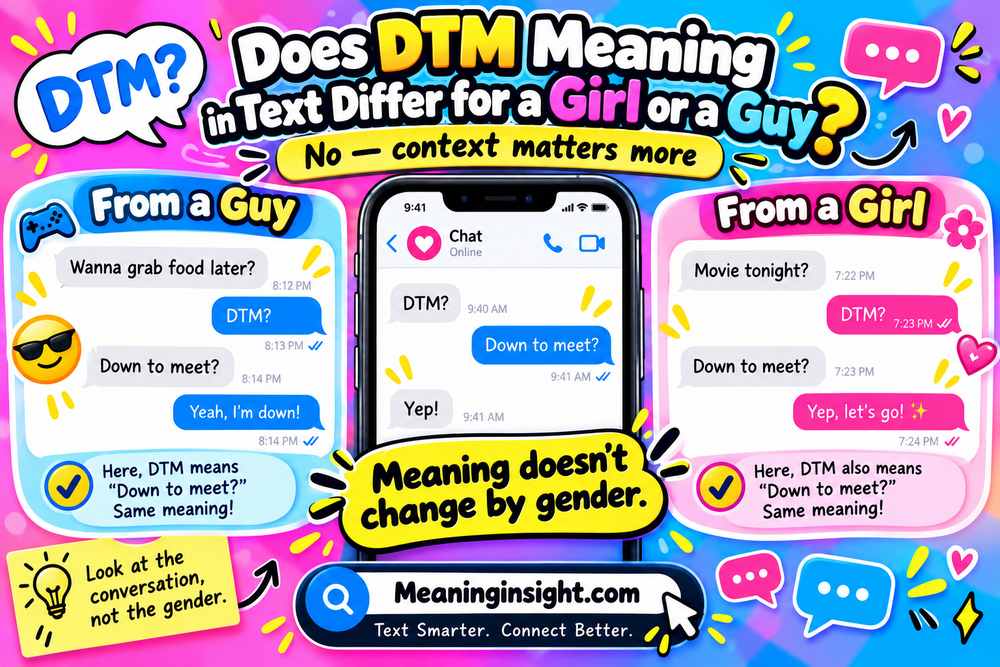
No. DTM does not have different official definitions for different genders.
This can be used by girls and guys alike to make fun of exaggerations, poke at friends or talk about meeting places. Rather, context provides the key to the message it conveys.
DTM Meaning in Text From a Guy
Suppose a guy writes:
“You bought me all these gifts? You’re DTM!”
He might be pleasantly surprised by the effort.
However, “You’re DTM, stop calling me” communicates irritation.
Neither message automatically indicates romantic interest or rejection.
DTM Meaning in Text From a Girl
A girl might say:
“You planned our entire weekend already? DTM!”
Depending on her tone, she could be impressed or overwhelmed.
Alternatively, “Stop bringing up that argument. You’re DTM” communicates frustration.
Therefore, the person’s wording and behavior provide better clues than their gender.
Is DTM Rude, Flirty, Friendly, or Formal?
Yeah, we already know DTM is informal slang. However, it can carry several different emotional tones.
Can DTM Be Flirty?
Yes, especially when someone uses it to tease a person they like.
For example:
“You brought flowers and my favorite coffee? You’re DTM, but that’s adorable.”
The surrounding words create the affectionate tone.
Can DTM Be Friendly?
Absolutely.
“You made matching shirts for our trip? DTM!”
Among close friends, this may express amusement.
Can DTM Sound Rude?
Yes. Calling someone excessive during an emotionally serious moment may feel dismissive.
For instance:
“I’ve been worried about this all day.”
“You’re DTM.”
Even if intended casually, that response could hurt someone’s feelings.
Can DTM Sound Formal?
Usually not.
Instead of telling a colleague, “You’re DTM with these revisions,” explain what needs adjusting.
For example:
“The current level of detail may be unnecessary for this presentation.”
This communicates the concern without sounding insulting.
How to Reply When Someone Says DTM
So, understanding the DTM Meaning in Text can help you respond confidently without overreacting.
If someone is teasing:
“Haha, I know. I got carried away!”
If you think their criticism is unfair:
“I understand your point, but this matters to me.”
If they seem uncomfortable:
“Sorry, I didn’t realize I was overwhelming you.”
Meanwhile, if DTM appears in a conversation about meeting up, ask:
“Do you mean you’re down to meet?”
Clarifying is especially helpful if the short form could stand for different phrases.
Is DTM Appropriate in Every Conversation?
Not always. DTM is basically informal, where both sides know the slang.
Be sure not to overuse it when writing professional emails, academic papers, customer complaints, disputes about substantial issues and anything that is very likely to provoke an emotional response.
For instance, not to mention it would be seen as disrespectful to label a customer “DTM,” especially if they were asking several questions.
Instead, answer their queries more explicitly.
Be clear with the DTM; also don’t use it as a substitute for an important boundary when someone might mistake it.
Saying “do not chat me tonight” sends a signal far more expediently.
How DTM Is Used in Different Types of Conversations
DTM can describe behavior, express criticism, or occasionally communicate another intention. For example, Friends may jokingly use it, or someone in an argument may mean it more seriously. The next examples show how the same abbreviation gives different feelings.
| Situation | Example | Likely Intent |
| Friends | “You brought five snacks? DTM!” | Playful teasing |
| Dating | “Three bouquets? You’re DTM!” | Affectionate surprise |
| Family chat | “You’ve called six times. DTM.” | Mild frustration |
| Gaming | “You built an entire castle? DTM!” | Admiration |
| Argument | “You’re DTM over nothing.” | Criticism |
| Shopping | “Ten pairs of shoes? DTM!” | Surprise |
| School project | “Forty slides? You’re DTM.” | Excessive effort |
| Weekend plans | “I’m free tonight. DTM?” | Possible invitation |
Best Conversational Replies to DTM in Different Situations
You answer back matching the tone and intent of the other person. While DTM often comes across as harsh, it can also be lighthearted or even complimentary. So that you do not put any unnecessary strain, here are some responses that you can give.
| Situation | Natural Reply |
| Friendly teasing | “Haha, I know!” |
| Excessive preparation | “I just wanted everything perfect.” |
| Someone feels annoyed | “Sorry, I’ll ease up.” |
| Unfair criticism | “I don’t think I’m overdoing it.” |
| Flirty conversation | “Only because you’re worth it!” |
| Meeting invitation | “Sure, where should we meet?” |
| Unclear meaning | “What do you mean by DTM?” |
| Request for space | “I understand. I’ll give you space.” |
DTM vs Similar Texting Slang
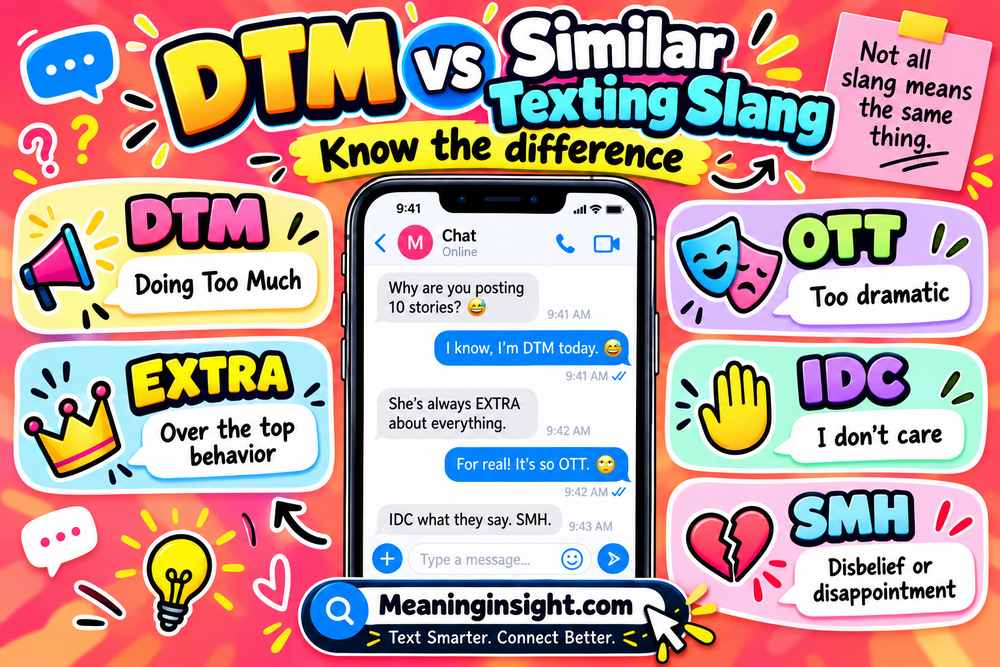
Several slang expressions describe excessive behavior, emotional reactions, or frustration. Nevertheless, they aren’t interchangeable. For example, saying “You’re DTM” directly describes someone’s behavior as excessive, while “SMH” mainly expresses disapproval or disbelief.
| Slang | Meaning | Main Difference |
| DTM | Doing Too Much | Describes excessive behavior |
| EXTRA | Overdramatic or excessive | Similar meaning without abbreviation |
| OTT | Over the Top | Describes exaggerated behavior |
| IDC | I Don’t Care | Expresses indifference |
| SMH | Shaking My Head | Shows disappointment or disbelief |
| NVM | Never Mind | Withdraws a subject or request |
| TBH | To Be Honest | Introduces an honest opinion |
| FR | For Real | Emphasizes sincerity or agreement |
| RN | Right Now | Refers to the present moment |
Common Mistakes to Avoid When Understanding DTM
One common mistake is assuming DTM always means “Don’t Text Me.” In ordinary social media discussions, “Doing Too Much” is generally the more likely interpretation.
Another misunderstanding is treating every DTM comment as an insult. Sometimes people use it affectionately when someone makes an impressive effort. Furthermore, avoid confusing DTM with a definite romantic signal. A playful comment doesn’t automatically mean someone is flirting.
People also occasionally interpret brief abbreviations without reading previous messages. Consequently, they may respond defensively to something intended as a joke. Finally, remember that repeated unwanted contact deserves serious attention. If someone explicitly asks you to stop messaging, respect their request rather than focusing on which abbreviation they used.
Read More: What Does MK Mean in Text: Definition, Uses & Real Examples
Other Meanings of DTM Outside Casual Texting
Outside everyday slang, DTM has established technical meanings. For example, Digital Terrain Model is used in surveying, mapping, and geographic information systems to represent terrain elevation.
In telecommunications, Dual Transfer Mode describes a capability associated with certain mobile network technologies. Additionally, DTM may appear as initials in organizational names or specialized documents. However, these meanings generally don’t apply when someone comments “You’re DTM” on a friend’s social media post.
Therefore, recognizing the subject of the conversation helps distinguish internet slang from technical terminology.
Conclusion
DTM is most commonly a slang expression used when someone’s actions seem exaggerated, excessive, or unnecessarily dramatic. Nevertheless, it can occasionally stand for “Don’t Text Me,” “Down to Meet,” or another context-specific phrase.
Understanding the DTM Meaning in Text becomes much easier when you consider the sender’s wording, emotional tone, and previous messages. If someone uses it playfully, a humorous response may be appropriate. However, when the message expresses genuine frustration, respond respectfully rather than escalating the conversation.
Ultimately, the best way to handle unfamiliar slang is to understand the context, recognize the person’s intentions, and ask for clarification when necessary.
FAQs About DTM Meaning in Text
What does DTM mean in texting?
DTM most commonly stands for “Doing Too Much.” It describes behavior considered exaggerated, excessive, or unnecessarily dramatic.
Does DTM mean Don’t Text Me?
Sometimes. Although less common than “Doing Too Much,” it may mean “Don’t Text Me” when someone wants space or doesn’t wish to continue a conversation.
What does DTM mean on Snapchat?
On Snapchat, DTM generally means “Doing Too Much.” Users may send it when reacting to excessive snaps, repeated messages, or dramatic behavior.
Is DTM an insult?
Not always. DTM can be playful, affectionate, or critical depending on the conversation and relationship between the people involved.
What does DTM mean from a crush?
It depends on the surrounding message. A crush might be teasing you, criticizing something you did, or occasionally asking whether you’re available to meet.
Can DTM mean Down to Meet?
Yes. “Down to Meet” is another recognized interpretation, particularly when someone is discussing availability or making social plans.
What’s the difference between DTM and EXTRA?
Both can describe exaggerated behavior. However, DTM abbreviates “Doing Too Much,” while “extra” is a slang adjective used to describe someone acting excessively.
How should I reply when someone says DTM?
If the message is playful, respond with humor. If it sounds critical, acknowledge the concern or explain your perspective. When the intended meaning is unclear, ask directly.